
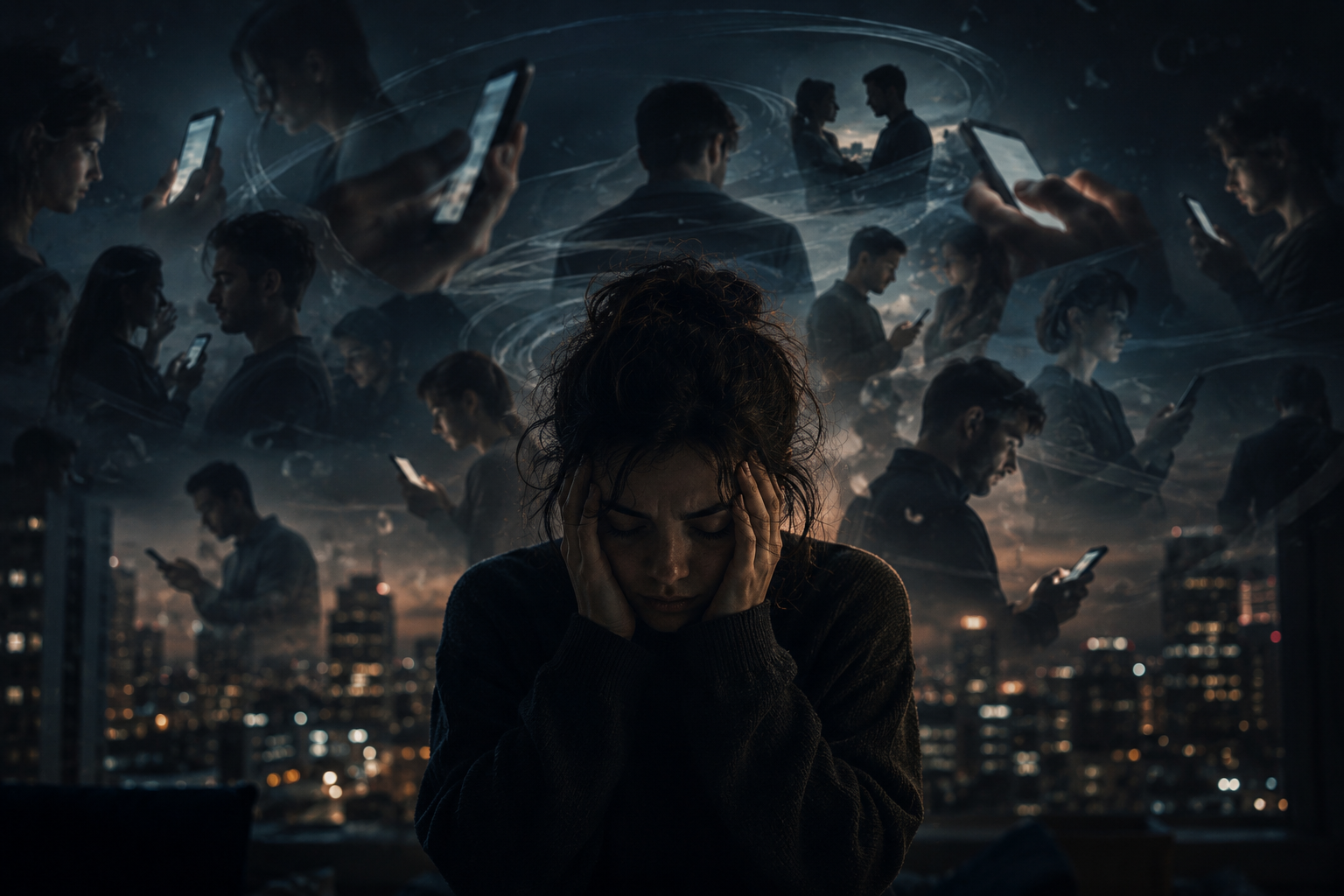
Modern dating is exhausting in ways people still struggle to articulate properly.
Not because people suddenly became weaker.
Or softer.
Or incapable of commitment.
The deeper issue is more physiological than most conversations about modern relationships are willing to admit.
People are now attempting to build intimacy inside overstimulated nervous systems.
And nervous systems shape relationships far more than modern dating discourse acknowledges.
Especially now.
Especially in a culture where emotional access has become nearly continuous.
A person can wake up to unresolved emotional ambiguity before their feet even touch the floor.
Unread messages.
Delayed replies.
Typing indicators.
Instagram stories.
Seen receipts.
Silence where reassurance was expected.
Attention where distance was expected.
Tiny emotional interruptions all day long.
None of them individually catastrophic.
But collectively exhausting.
That exhaustion matters.
Because the human nervous system was never designed for perpetual romantic accessibility.
For most of human history, emotional distance existed naturally.
People disappeared into daily life.
Space existed by default.
Anticipation existed naturally.
Absence existed naturally.
Emotional rhythm existed naturally.
Now emotional contact follows people everywhere.
Into work.
Into bed.
Into bathrooms.
Into airports.
Into dinner tables.
Into moments that once belonged to psychological stillness.
Modern intimacy increasingly unfolds inside continuous low-level nervous system stimulation.
That changes relationships profoundly.
Especially attraction.
Especially emotional presence.
Especially anticipation.
People often frame modern dating as a psychological problem.
But many modern relational dynamics are actually nervous system dynamics wearing psychological language.
People say:
“I’m emotionally unavailable.”
when sometimes they are emotionally flooded.
There is a difference.
Flooded people often still crave intimacy.
Still crave closeness.
Still crave connection.
But their nervous systems are overloaded by the amount of emotional input modern life now demands they process continuously.
That overload creates strange relational behaviors.
Hypervigilance.
Emotional buffering.
Withdrawal.
Texting fatigue.
Emotional inconsistency.
Delayed responses.
Overthinking.
Detachment disguised as independence.
And because modern culture interprets all relational behavior psychologically first, people often misunderstand what is actually happening underneath.
Not every emotionally distant person is avoidant.
Not every inconsistent person lacks care.
Not every emotionally exhausted person lacks depth.
Sometimes the nervous system simply cannot metabolize the volume of emotional stimulation modern dating now produces.
That stimulation comes from everywhere.
Dating apps.
Social media.
Perpetual accessibility.
Infinite optionality.
Continuous comparison.
Algorithmic desirability culture.
Emotional performance culture.
Hyper-awareness.
People now carry unresolved emotional ambiguity in their pockets all day long.
That sentence sounds poetic until someone notices how physically true it feels.
A single unread message can alter someone’s nervous system state for hours.
A delayed reply can trigger emotional interpretation loops all afternoon.
A change in texting tone can linger psychologically through an entire evening.
Modern people are rarely fully offline emotionally anymore.
And that creates a form of relational fatigue many people do not yet have language for.
Especially because modern communication culture rewards emotional availability while simultaneously overwhelming the nervous system’s capacity to sustain it.
Everyone is expected to:
→ communicate constantly
→ remain emotionally reachable
→ process continuously
→ clarify intentions immediately
→ emotionally regulate in real time
→ tolerate perpetual ambiguity
→ remain psychologically self-aware
→ manage tone endlessly
That is an extraordinary amount of nervous system labor.
Especially when layered on top of careers, financial pressure, social performance, algorithmic comparison, and modern attention fragmentation.
Eventually people stop feeling emotionally present.
They start feeling emotionally interrupted.
That interruption changes intimacy in subtle but powerful ways.
Because intimacy requires immersion.
And immersion becomes difficult when attention is perpetually fractured.
You can feel this in modern conversations constantly now.
Two people sitting together physically while both nervous systems remain partially elsewhere.
One eye on the phone.
One layer of attention monitoring notifications.
One layer of attention managing perception.
One layer of attention interpreting the interaction itself in real time.
Modern people increasingly struggle to fully arrive emotionally anywhere.
Not because they do not care.
Because their nervous systems rarely fully settle.
This creates a strange contradiction inside modern dating culture.
People crave deep connection while simultaneously existing inside conditions that fragment emotional depth constantly.
The nervous system starts adapting accordingly.
People become emotionally buffered.
Emotionally cautious.
Emotionally delayed.
Not always consciously.
Sometimes physiologically.
Because overstimulation changes relational behavior over time.
Especially attraction.
Attraction requires a certain degree of emotional presence.
Curiosity.
Attention.
Anticipation.
Psychological openness.
But overstimulated nervous systems become defensive systems.
Monitoring systems.
Self-protective systems.
And self-protective systems do not experience intimacy the same way relaxed systems do.
This is part of why modern dating often feels simultaneously hyper-connected and emotionally hollow.
Everyone is communicating.
Very few people feel fully reached.
The interaction itself becomes fragmented.
People are no longer only experiencing each other.
They are experiencing:
- themselves being perceived
- their response timing
- the meaning of silence
- social comparison
- emotional positioning
- perceived options
- imagined future outcomes
- algorithmic desirability
All simultaneously.
Eventually people stop inhabiting the interaction naturally.
They start monitoring themselves inside it.
That self-monitoring changes attraction quietly.
Because attraction often requires psychological immersion.
And immersion disappears once self-consciousness becomes too dominant.
This is why many modern relationships feel emotionally heavy surprisingly quickly. The nervous systems involved are already exhausted before intimacy even fully forms.
People are not only dating each other anymore.
They are dating inside permanently overstimulated nervous systems.
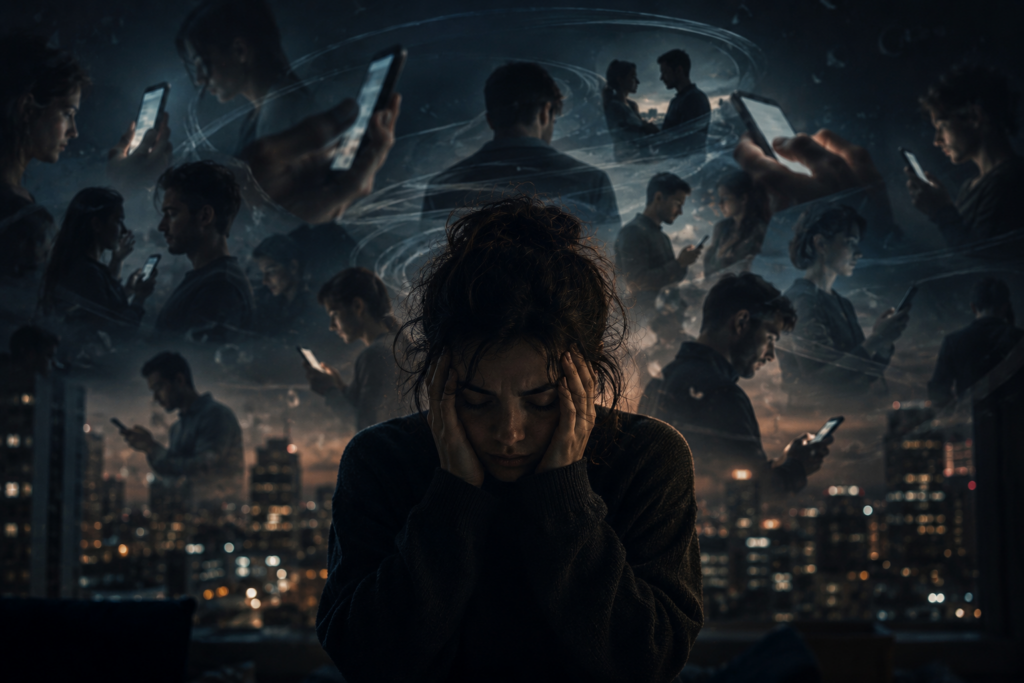
People now enter relationships carrying:
→ unresolved dating fatigue
→ emotional overstimulation
→ ambiguity residue
→ comparison culture
→ previous emotional fragmentation
→ attachment to digital reassurance loops
→ chronic nervous system activation
All while trying to appear emotionally grounded.
That pressure creates emotional performance culture.
People become skilled at sounding emotionally intelligent while remaining physiologically overwhelmed underneath.
Modern dating increasingly rewards emotional presentation rather than emotional embodiment.
That distinction matters.
Because the body always feels what the performance cannot sustain indefinitely.
This is why many people now describe dating as:
→ draining
→ exhausting
→ emotionally confusing
→ psychologically consuming
even when nothing objectively terrible happened.
Their nervous systems are overloaded by perpetual emotional processing.
And modern dating culture rarely allows true recovery.
There is always another notification.
Another possibility.
Another ambiguity.
Another emotionally unresolved interaction.
Another person appearing emotionally accessible but psychologically unavailable.
Another conversation floating in unfinished emotional space.
Humans were not designed for this amount of simultaneous romantic ambiguity.
Especially not indefinitely.
That ambiguity changes emotional pacing dramatically.
Historically attraction unfolded through periods of anticipation and uncertainty naturally shaped by physical life itself.
Now uncertainty arrives artificially through communication inconsistency, digital overload, and emotional fragmentation.
That creates nervous system instability rather than emotional tension.
The distinction is important.
Healthy attraction contains emotional aliveness.
Modern dating often contains emotional overstimulation.
Those are not the same experience.
And people confuse them constantly now.
Overstimulated nervous systems often mistake:
→ inconsistency for chemistry
→ anxiety for attraction
→ intermittent attention for depth
→ emotional unpredictability for intensity
Because the nervous system becomes conditioned to spikes.
Not steadiness.
This is part of why emotional exhaustion now exists alongside emotional obsession so frequently.
People feel simultaneously overwhelmed and emotionally fixated.
That contradiction is one of the defining emotional signatures of modern dating culture.
Especially online.
Especially in app-based environments.
Because dating apps do not simply change access to people.
They change emotional pacing itself.
Humans were never meant to psychologically process this many potential romantic outcomes continuously.
The nervous system struggles under infinite possibility.
Especially when combined with comparison culture.
People now compare:
→ attention
→ attractiveness
→ emotional availability
→ lifestyle
→ desirability
→ relationship aesthetics
→ intimacy performance
almost unconsciously.
That creates chronic nervous system tension beneath modern connection.
And tension sustained too long eventually becomes exhaustion.
This exhaustion explains many modern relational behaviors more accurately than simplistic psychology frameworks do.
Not everyone is avoidant.
Not everyone is emotionally immature.
Not everyone lacks relational capacity.
Many people are simply overwhelmed.
Emotionally saturated.
Psychologically overexposed.
Nervous systems carrying more emotional stimulation than they evolved to process continuously.
That reality deserves more honest conversation than modern dating discourse currently allows.
Because most conversations about relationships still operate at the level of behavior alone.
But behavior is often downstream from nervous system state.
A dysregulated nervous system changes:
→ attraction
→ attention
→ emotional pacing
→patience
→ responsiveness
→ intimacy tolerance
→ emotional resilience
→ communication quality
People do not experience connection purely psychologically. They experience it physiologically first. The body registers safety, tension, pressure, anticipation, overwhelm, and emotional availability before conscious interpretation fully forms.
Modern nervous systems are increasingly overloaded before intimacy even begins. Maybe that is why so many people feel exhausted by dating before they ever reach actual connection.
Not because they stopped wanting intimacy.
But because modern dating increasingly asks the nervous system to remain emotionally open inside conditions of perpetual stimulation, ambiguity, interruption, and emotional performance.
That is an extraordinarily difficult environment for human connection to fully breathe inside.
Especially sustained human connection. Especially emotionally alive connection.
And maybe that is why modern relationships increasingly feel emotionally complicated before they even become emotionally deep.
Not because humans forgot how to connect.
But because modern culture quietly changed the nervous system conditions connection now has to survive inside.
Leave a Reply